Does Shockwave Therapy Really Work? What the Research Says
Shockwave trials for chronic heel pain reached opposite conclusions, and that confuses a lot of patients. Dr. Farhan Abdullah breaks down three randomized trials, what the mechanism research does and doesn't prove, and where shockwave fits for tendon problems that haven't responded to conservative care. He also explains what a SoftWave course involves at Magnolia Functional Wellness in Southlake and how to tell whether it's working.


By Dr. Farhan Abdullah, DO | Medical Director, Magnolia Functional Wellness | Southlake, TX
Two shockwave trials. Same condition, same decade, published a few years apart. One concluded that shockwave therapy was ineffective for chronic heel pain. The other concluded it improved pain, function, and quality of life compared with placebo. If you've ever Googled whether shockwave works, you've probably landed in the middle of that argument and walked away more confused than when you started.
I'm Dr. Farhan Abdullah, an internal medicine physician, and at Magnolia Functional Wellness in Southlake we offer SoftWave therapy for tendon, joint, and soft tissue problems. Patients ask me about the evidence constantly, and they deserve a better answer than a sales pitch. So here's the version I give in the exam room, including the parts that don't flatter my own treatment menu.
Why the Research Looks Like It's Arguing With Itself
The most studied use of shockwave therapy in musculoskeletal medicine is chronic plantar fasciitis, the stubborn heel pain that makes your first steps out of bed feel like walking on a thumbtack. Early on, the results were all over the map.
In 2002, Buchbinder and colleagues published a double-blind, randomized, placebo-controlled trial in JAMA. They enrolled 166 people with ultrasound-confirmed plantar fasciitis and gave half of them three weekly sessions of ultrasound-guided shockwave. The other half got a sham treatment at a tiny fraction of the energy. At 6 and 12 weeks, both groups improved by about the same amount, and the authors found no evidence of benefit over placebo.
A year later, Haake and colleagues ran a larger randomized, blinded trial in Germany, published in the BMJ. They randomized 272 patients whose heel pain hadn't budged for at least six months. The success rate at 12 weeks was 34 percent with shockwave and 30 percent with placebo. Their conclusion was blunt, and you can read it in the BMJ trial abstract.
Then came Gerdesmeyer and colleagues in 2008, in the American Journal of Sports Medicine. They studied 245 patients with chronic plantar fasciitis and compared three treatments with a radial device against placebo. At 12 weeks, the overall success rate was 61 percent in the treated group versus 42 percent with placebo, and the gap widened at 12 months. That's the radial shockwave trial I point to most often.
So which one is right? Maybe all of them, and that's not a dodge. These trials used different devices, different energy levels, different numbers of impulses, and different patient selection. Lumping them together as "shockwave" is a bit like comparing a walk around Southlake Town Square to a half marathon because both involve shoes. Dose matters. Technique matters. Who you treat matters.
What the Mechanism Research Adds
The clinical trials tell you whether people feel better. The laboratory work tries to explain why they might. A 2020 review in the Journal of Clinical Orthopaedics and Trauma by Simplicio and colleagues, titled Extracorporeal shock wave therapy mechanisms in musculoskeletal regenerative medicine, pulls together what's been proposed: mechanical signals that cells convert into biochemical ones, increased local blood vessel growth, changes in inflammatory signaling, and stimulation of repair-related cells in the tissue.
I want to be careful here, because this is where marketing tends to outrun science. Laboratory and animal findings describe what shockwaves can do to tissue under controlled conditions. They don't prove that every patient sitting in a treatment chair gets those effects, or that those effects translate into less pain by themselves. Mechanism studies make the treatment plausible. Randomized trials in people decide whether it works.
There's also a device question I'd rather say out loud. The trials I just described tested radial and focused shockwave systems. SoftWave is a different technology, an electrohydraulic device that produces an unfocused wave over a broader area. I think the underlying biology is similar enough to take the broader shockwave literature seriously. But I can't tell you the plantar fasciitis trials above were done with SoftWave, because they weren't, and you should be a little skeptical of any clinic that implies otherwise.
Where I Think Shockwave Earns Its Place
Here's how I translate all of that into practice. Shockwave isn't a miracle, and it isn't a gimmick either. It's a reasonable, low-risk option for a specific kind of patient: someone with a chronic soft tissue problem, usually a tendon or the tissue where a tendon or fascia meets bone, who has already given the usual conservative stuff a fair shot. Stretching, strengthening, activity changes, better shoes, physical therapy. The person who says "I've been doing everything right for six months and I'm still hurting."
That group is where I see it help most often. Chronic tendon and fascia problems tend to sit in tissue with poor blood supply, and they can stall in a half-healed state. Anything that nudges that tissue to restart repair, without a needle or a steroid, is worth a serious look. That's also why I'm wary of repeated cortisone injections into the same tendon. They can calm things down for a while, but they don't rebuild anything.
Where I'm more cautious: acute injuries that are still angry and swollen, complete tendon tears, nerve problems driven by something structural like a herniated disc pressing on a nerve root, and anyone hoping a single session will undo ten years of wear. I'll tell you plainly when I think you're better served by imaging, a referral, or a surgical opinion. In my practice, an honest "this isn't the right tool for you" matters more than filling a treatment slot.
What a SoftWave Course Actually Looks Like
Let's get practical, because most people want to know what they're signing up for.
The first step isn't the device. It's an exam. I want to know where it hurts, what makes it worse, what you've already tried, and whether the pain is coming from the structure you think it is. Heel pain, for example, isn't always the plantar fascia. Sometimes it's a nerve, a fat pad, a stress reaction in the bone, or referred pain from the low back. Treating the wrong target with the right tool gets you nowhere. Imaging comes into play when the picture isn't clear.
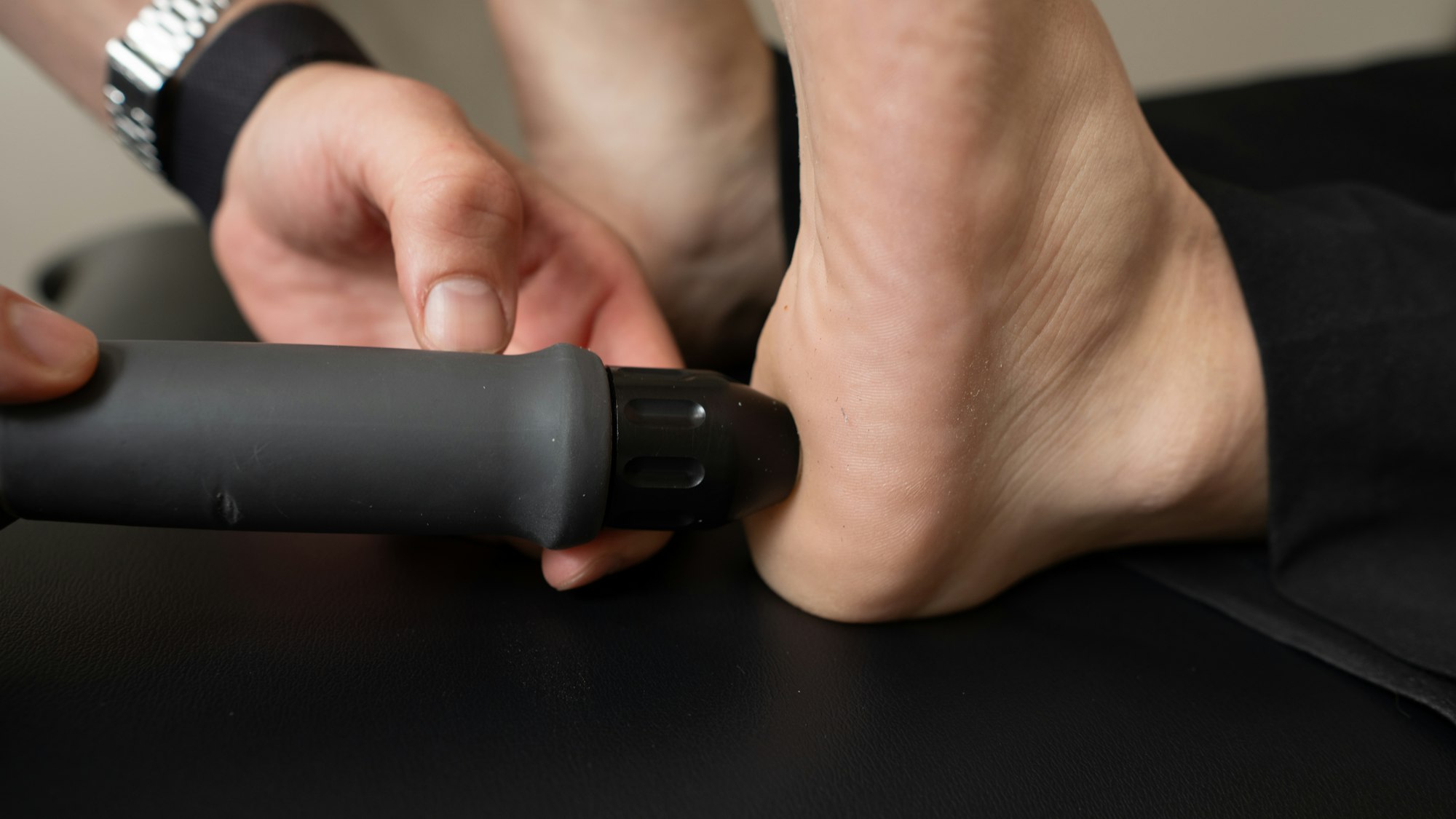
A typical course is a series of short sessions over several weeks, not a one-and-done visit. A session usually runs about fifteen to twenty minutes. You'll feel a tapping or pulsing sensation, and it can get a little intense over a very tender spot, but most people tolerate it without numbing. There's no incision, no injection, and no recovery period afterward. You can walk out and get on with your day. Patients here in North Texas often schedule around work or kids' practices at Bob Jones Park, and that's perfectly workable.
The question I get next is always the same: when will I feel it? Some people notice a difference after a few sessions. Many don't, and that isn't a red flag. Tissue repair keeps going for weeks after the last treatment, which is why I usually reassess at about six to twelve weeks rather than judging by day ten. If someone has had a full course and nothing has changed, I'd rather change the plan than keep stacking sessions.
A few ground rules make a real difference. Skip ibuprofen and naproxen around treatment if you can, since anti-inflammatories may dull the healing response we're trying to use. Keep moving, but don't push through sharp pain. Pair the treatment with whatever fixes the underlying problem, whether that's calf strength for the heel, a running mileage plan, or hip stability for the knee. The device can help tissue recover. It can't change the habit that overloaded it in the first place.
One more thing about expectations. Safety is a real part of why I'm comfortable offering this. In both the Gerdesmeyer and Haake trials, few or no relevant side effects were reported, and the most common complaints in shockwave care are short-lived soreness or redness over the treated area. That favorable safety profile is a big reason it makes sense as an early, low-risk step for a chronic problem. It also means the decision often comes down to a simple question: is a series of short, needle-free visits worth trying before we consider anything more invasive? For many people the answer is yes.
How to Judge Whether It's Working
This is where a lot of well-meaning treatment plans quietly fall apart. Pain scores on a given Tuesday are a lousy yardstick. They swing with weather, sleep, stress, and how many stairs you climbed the day before.
I'd rather track function. Can you take your first steps in the morning without wincing? Can you finish the walk, the round of golf, or the workout you used to skip? Are you reaching for pain relievers less often? Those answers are harder to fool yourself about, and they're what actually changes your life. A simple note on your phone every week or two works better than memory, because we're all wired to remember the flare-ups and forget the ordinary good days.
If you're making progress but not all the way there, there are options. For some tendon problems, I'll sequence a SoftWave course first and then add PRP once the tissue has been primed. For others, the right answer is more rehab and patience. And occasionally it's a conversation about whether something structural has gone far enough that a surgeon should weigh in.
A Fair Summary
Here's where I land, and I'd say the same thing if you were sitting across from me. The shockwave literature is mixed, mostly because it's a messy mix of devices, doses, and patients. The best-supported use is chronic plantar fasciitis and similar tendon problems that haven't responded to conservative care, and even there, trials disagree. Mechanism research gives good reasons to think the treatment does something biologically meaningful, but it isn't proof by itself. And a clinic that promises results for every ache and every patient is selling more than the evidence supports.
If you're curious whether this might fit your situation, you can read more about SoftWave shockwave therapy at Magnolia Functional Wellness and what we treat. What I'd encourage is to come in with your history, your prior treatments, and your goals, and let's work out whether you're a candidate or whether something else makes more sense. That's how we do it here in Southlake, and I'd rather earn your trust with an honest answer than a promise.
Your Questions Answered
Led by trained medical professionals delivering safe, effective, and scientifically backed aesthetic and wellness treatments.
Will SoftWave help my chronic plantar fasciitis if I'm a runner?
It's one of the better-supported uses of SoftWave. Multiple level I trials, summarized in a 2024 Br J Sports Med systematic review on athletes, found that ESWT can be effective alone for plantar fasciitis, and a 2024 Arch Orthop Trauma Surg meta-analysis showed measurable reductions in plantar fascia thickness on imaging. In my Southlake clinic, runners who've already tried stretching, orthotics, and a cortisone shot or two tend to be some of the strongest responders to a SoftWave course, especially when we also clean up their footwear, mileage progression, and calf strength at the same time.
Can I keep training while I'm doing a SoftWave course?
In most cases, yes. One of the practical advantages of SoftWave is that it doesn't require downtime. The vast majority of my patients at Magnolia Functional Wellness in Southlake keep up their regular workouts, runs, and league play through the course. The main exception is when we're working on something acutely irritated, where I'll usually pull back the volume for a week or two while we get the inflammation under control. The other big rule: skip NSAIDs like ibuprofen and Aleve for a few days before and a week or two after each session, since they blunt the healing response we're trying to use.
Is SoftWave a better option than cortisone for tendon injuries?
For chronic tendon issues, I usually prefer SoftWave over repeat cortisone, and not because cortisone is useless. Cortisone reliably calms pain in the short term. The problem is that repeated steroid injections into a tendon can weaken the tissue over time, which is the opposite of what we want for someone planning to stay active for another 30 years. SoftWave works in the other direction. It encourages the body to remodel and rebuild the tissue instead of muting the pain signal. That said, cortisone still has a role for specific situations and short-term relief, and at Magnolia Functional Wellness we choose based on the patient and the injury, not on dogma.
How will I know if SoftWave is working for my tendon pain?
I'd watch function more than pain scores. Can you take your first steps in the morning, finish your walk or workout, and reach for pain relievers less often? Tissue repair keeps going for weeks after the last session, so at Magnolia Functional Wellness in Southlake I usually reassess at six to twelve weeks, and if nothing has changed we adjust the plan instead of repeating the same course.
Need More Information?
Our team is ready to answer your specific questions and concerns.